
Self Awareness
Understanding your emotions
Summary
01
Spend time by yourself
02
Asking “why” emotions are there
03
Notice how the emotions feel in your body
Knowing yourself is the beginning of all wisdom - Aristotle
I want you to fix this engine, but…
Imagine you are driving a car and a check engine light comes on. What should you do?
What would happen if you ignored it?
Emotions are signals. They tell us when we feel that things are going right or wrong.
Imagine trying to fix you car engine but you couldn’t look at it! The first step in helping how you feel is understanding what is actually going on in your mind.


Self awareness is defined as self-focused attention or knowledge.
This means that you understand what your mind is doing and why it’s happening.
What is it?
Better control over bad habits
Reduce negative emotions
The first step to improving mental health
Helps you figure out what the actual problem is
Benefits

Emotions Overview
So what are emotions?
So as stated earlier, emotions are signals. They are a summary your brain gives you based on how you are interpreting the world. This story can be summarized in things like anxiety when we fear the unknown, or joy when celebrating with others.
Importantly, there are no “bad” emotions. We may find negative emotions uncomfortable and not enjoy them, but they provide us with very important information and sometimes motivation to address problems. When you feel emotions, it can be very useful to understand why? Where is it coming from, how are you interpreting the world? Is this accurate to the current situation, or something you learned from the past.
Even just putting words to feelings can reduce the intensity of them by using a different part of the brain!
How body temperature changes with emotional changes →
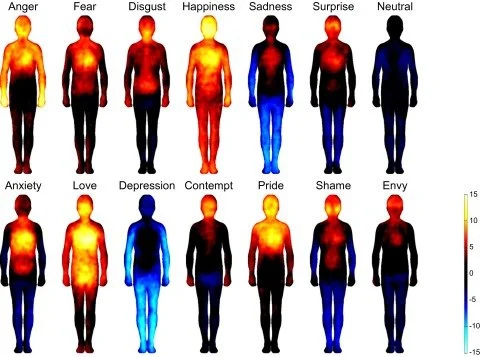
(Nummenmaa et al., 2013)
-
Click on this video to watch an old lady talk about her experience with therapy. Ask yourself “why” did she act the way she did.
For context, her therapist is called Jung, the man she refers to at the start.
-
Because she didn’t know what she should do in life
-
The therapist would not tell her what to do. This frustrated her as she felt that everyone was always mean to her
-
Because she was being mean to them
-
Anger felt good to her. It helped her to cope with other negative feelings, helping her to not feel “small”
-
She originally went to therapy because of not knowing what to do in life. This then revealed how she interacted with others, showing how she felt about how she was treated, how she treats others, and why this happens.
The real problem was feeling “small” and using anger to cope with that feeling. Understanding can help with fixing
Using “why” to build awareness
First I accept myself as I am, then I change - Carl Rogers
Alexithymia (emotional colour blindness)
What do we do if we look inside and we don’t see much going on, that we find it hard to figure out how we are feeling?
One thing to do is focus on how we physically feel. Do you have butterflies in your stomach? Is you heart racing? Are your shoulders tense? By paying attention to this, you can figure out what you are emotionally feeling based on what you are physically feeling.
Awareness for Breaking Bad Habits
-
When do you “do” this thing. Are you stressed, tired, angry, lonely etc. Is it first thing you do when you wake up? Being aware and understanding the habit is the first step.
-
One way to interrupt bad habits is to remove the “cue”. This is the spark that starts the habit. For example, leave your phone outside your room at night. If it is not beside you in the morning, there’s no cue. Do you only do something when stressed, if so, do you understand how to manage the stress?
-
This means being in the present, without your mind wandering everywhere. One way to improve this is through meditation. Another is focusing on your feelings in the moment when you are wanting to or in the middle of the habit. You know how doomscrooling can feel mindless? This is the opposite of that. It can even reduce how “good” doomscrooling feels, likely making it easier to stop.


Meta-Cognition
Thinking about thinking
This skill is used when we try to take a step back and put words to how we feel and see our emotions from a bit of a distance.
By practicing this, we can increase motivation, reduce how intense negative emotions feel, and navigate the scenarios causing the emotions better.
One useful skill is to talk to yourself in the third person. Not “I feel this way” but “David feels angry because…” or “Mary feels sad because…”.
Can you be too self aware?
Absolutely. Focusing internally all the time can bring its own issues. This is covered in the social anxiety section linked below.

-
Rogers, C. R. (1995). On becoming a person: A therapist's view of psychotherapy. Houghton Mifflin Harcourt.
-
Janssen, L. K. (2017). Breaking bad habits-A meditation on the neurocognitive mechanisms of compulsive behavior. Sl: sn.
-
Clear, J. (2018). Atomic habits: An easy & proven way to build good habits & break bad ones. Penguin.
-
APA Dictionary of Psychology. (2018). Dictionary.apa.org. https://dictionary.apa.org/self-awareness
-
Ferriss, T. (2022). Dr. Gabor Maté on How to Process Anger and Rage | The Tim Ferriss Show. In YouTube. https://www.youtube.com/watch?v=Yh1-y3TzSO4
-
Nummenmaa, L., Glerean, E., Hari, R., & Hietanen, J. K. (2013). Bodily maps of emotions. Proceedings of the National Academy of Sciences, 111(2), 646–651. https://doi.org/10.1073/pnas.1321664111
-
Description text goes here
-
Description text goes here
-
Description text goes here
-
Description text goes here
-
Description text goes here